Request for Callback
Fill out this form to download.
The brochure will be sent to the email you provide.
=


Fill out this form to download.
Thank You!
Your request for a callback has been successfully submitted. Our team will get in touch with you shortly. We appreciate your patience and look forward to speaking with you soon.
If you have any urgent concerns, please feel free to contact us directly at
+91 9007026542 or email us at [email protected]
Thank You for Your Interest!
Your request to unlock the free demo has been successfully submitted. Please check your email for further instructions and a link to access the demo. We hope you enjoy exploring the features and capabilities of our product.
If you have any questions or need further assistance, please feel free to contact us directly at
+91 9007026542 or email us at [email protected]
The brochure has been sent to your email. Kindly check your inbox, and if it’s not there, please check your spam or junk folder.
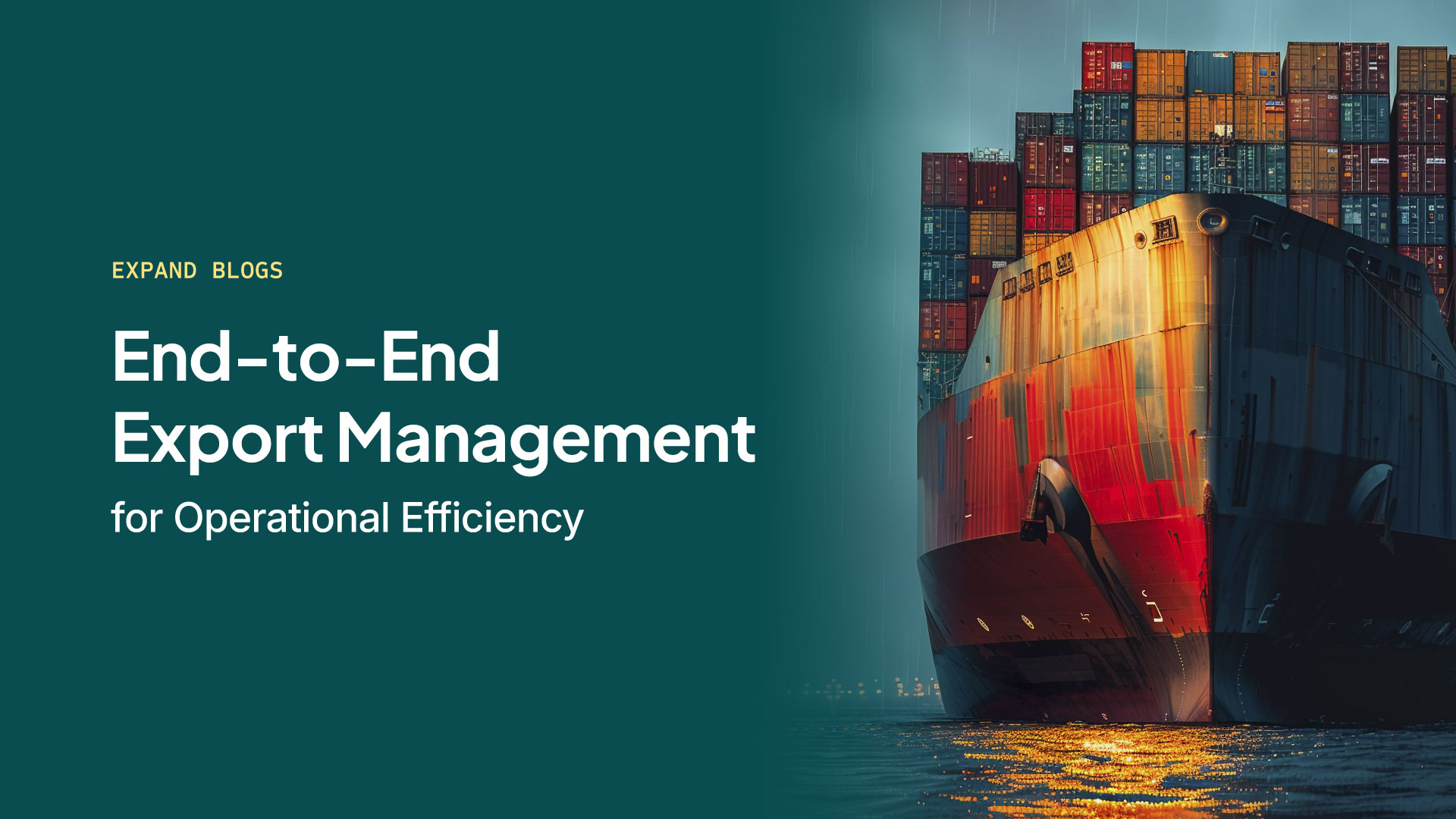
Export businesses operate in a highly coordinated environment where documentation, logistics, inventory, compliance, and finance must work in perfect sync. Any disconnect between these functions can quickly lead to delays, errors, and rising operational costs. As global trade becomes more competitive and customer expectations increase, exporters are under pressure to deliver faster, more reliably, and with greater transparency. This is why many export-driven businesses are adopting export ERP software to improve operational efficiency through end-to-end export management.
Eliminating Fragmented Processes Across Export Operations
One of the biggest challenges export businesses face is fragmented processes spread across multiple systems, spreadsheets, and teams. Order details may sit in one system, documentation in another, and logistics updates in emails or messages. These silos lead to duplicated work, inconsistent data, and frequent follow-ups. With integrated end-to-end export management software, all export-related activities—from order creation and documentation to shipment tracking and invoicing—are managed within a single platform. This unified approach eliminates manual handovers and ensures consistency across the export lifecycle.

Streamlining Workflows With Automation and Control
Operational efficiency depends heavily on how well workflows are defined, controlled, and executed. An export operations ERP automates repetitive and time-sensitive tasks such as document generation, internal approvals, status updates, and compliance checks. Automation reduces dependency on manual intervention, minimizes errors, and ensures that processes move forward without unnecessary delays. Clear workflow controls also help teams follow standardized procedures, improving accountability and reducing last-minute firefighting.

Improving Visibility Across the Export Lifecycle
Lack of visibility is a major reason export operations become inefficient. End-to-end export management provides real-time visibility into orders, documentation status, shipments, inventory movement, and financial transactions. Centralized dashboards allow export managers to track progress at every stage of the export cycle and identify bottlenecks early. This visibility not only helps in resolving issues faster but also builds confidence among customers and foreign buyers through timely updates and transparency.
Enabling Faster Decision-Making and Better Resource Utilization
When export data is centralized within export ERP software, reporting and analytics become more accurate and actionable. Export managers gain insights into turnaround times, operational costs, document processing delays, and logistics performance. These insights support faster decision-making, better planning, and optimal resource allocation. Instead of reacting to problems after they occur, businesses can proactively optimize processes and improve overall performance.

Building a Scalable and Efficient Export Operation
As export volumes increase, operational complexity grows across markets, products, and compliance requirements. End-to-end export management supported by an ERP system allows businesses to scale efficiently without adding administrative overhead. Standardized workflows, automation, and centralized data ensure that efficiency is maintained even as operations expand. This scalability enables exporters to grow confidently while maintaining control and consistency.
Conclusion
By leveraging export management software and an integrated export operations ERP, export businesses can achieve higher efficiency, improved coordination, and better visibility across the entire export lifecycle. End-to-end export management not only reduces operational costs and errors but also creates a strong foundation for sustainable growth in a competitive global trade environment.
Hosted on Certified Data Centers for Highest Level of Data Protection and Reliability.
Data Center Certifications


Your data and financial processes are tightly controlled and audited.


Built to protect high-risk financial data.


Security, quality, and continuity follow audited systems.