Request for Callback
Fill out this form to download.
The brochure will be sent to the email you provide.
=


Fill out this form to download.
Thank You!
Your request for a callback has been successfully submitted. Our team will get in touch with you shortly. We appreciate your patience and look forward to speaking with you soon.
If you have any urgent concerns, please feel free to contact us directly at
+91 9007026542 or email us at [email protected]
Thank You for Your Interest!
Your request to unlock the free demo has been successfully submitted. Please check your email for further instructions and a link to access the demo. We hope you enjoy exploring the features and capabilities of our product.
If you have any questions or need further assistance, please feel free to contact us directly at
+91 9007026542 or email us at [email protected]
The brochure has been sent to your email. Kindly check your inbox, and if it’s not there, please check your spam or junk folder.
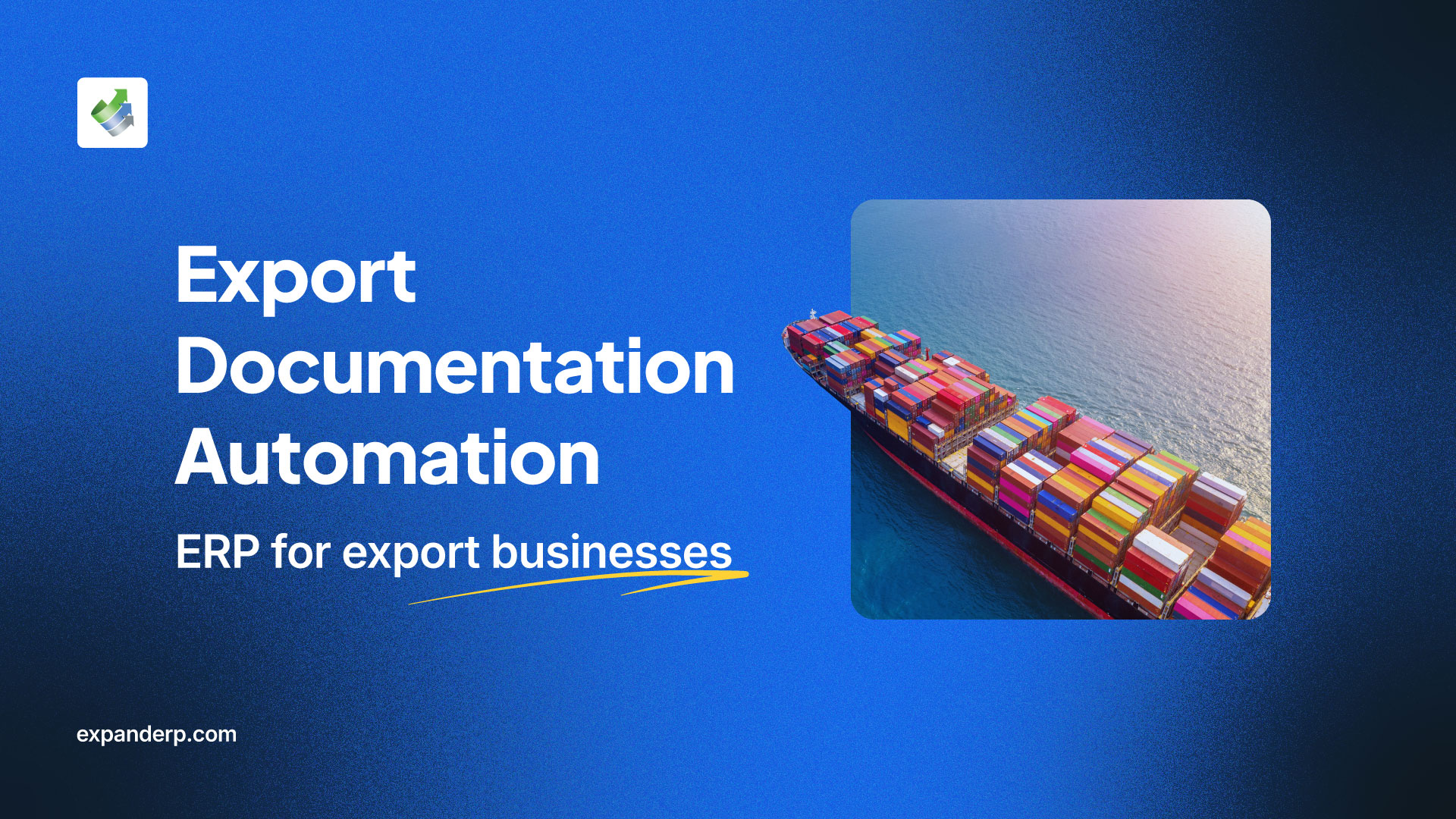
In today’s global trade environment, accurate export documentation isn’t just compliance, it’s a strategic advantage that directly affects margins, timelines, and customer satisfaction. Modern ERP for export businesses ties documentation, shipment visibility, and financial controls into a single automated workflow, helping exporters streamline operations and capture higher profitability.
Why Export Documentation Matters More Than Ever
Export documentation forms the backbone of international trade. From commercial invoices and packing lists to bills of lading and compliance forms. When these documents are incomplete or inaccurate, shipments can be delayed at customs, fines may be imposed, and working capital cycles are extended.
An integrated export management software or export ERP system ensures that all required paperwork is generated correctly, tracked centrally, and linked to shipment data, reducing risk and improving operational visibility.
1. Centralized Documentation Reduces Errors and Saves Costs
Manual paperwork is slow and prone to mistakes, especially when teams juggle multiple export documents and formats. By automating export documentation within an ERP for export businesses, companies:
Eliminate repetitive data entry
Ensure consistency across documents
Prevent costly fines and compliance issues
Accurate documentation reduces bottlenecks at customs and safeguards shipment timelines, ultimately contributing to improved margin performance.
2. Real-Time Shipment Visibility Enhances Planning and Execution
When documentation is generated manually or in disconnected systems, exporters struggle to match paperwork with shipment status. In contrast, an export ERP system with real-time visibility connects documentation with logistics and tracking data. This helps businesses:
Track container status from departure to delivery
Identify delays early
Adjust plans without disrupting customer commitments
This integrated visibility not only drives operational efficiency but also prevents hidden costs from delayed shipments, storage fees, or rush handling charges.
3. Automated Compliance Means Fewer Delays and Penalties
International trade regulations change frequently, and non-compliance can result in fines or rejected shipments. Modern export management software continuously checks export documents against regulatory requirements, helping exporters:
Meet customs and statutory documentation standards
Stay updated on global trade policies
Avoid penalties, rejections, or repeat paperwork requests
This proactive compliance management reduces uncertainty and protects margins by keeping goods moving.

4. Improved Financial Transparency and Cash Flow
Poor export documentation can delay invoicing and foreign remittance processes, creating cash flow bottlenecks. Integrated ERP for export businesses ties documentation status to finance modules so that:
Invoices are generated promptly
Foreign Remittance Certificates (FIRC) are tracked
Exchange rate impacts are accounted for automatically
This end-to-end linkage from documentation to finance minimizes delays in payment collection, helping exporters maintain healthier cash flow and tighter margins.
5. Better Collaboration and Document Version Control
Export processes involve multiple stakeholders such as sales, logistics, compliance, customs brokers, and finance teams. When different versions of documents circulate, mistakes happen. An export ERP system provides:
Centralized document storage
Version tracking and audit history
Shared, up-to-date visibility for all users
This transparency enhances coordination across teams, reducing rework and accelerating export cycle times.

Conclusion
For modern exporters, export documentation automation and real-time shipment visibility are essential levers for improving margins and operational efficiency. By adopting a robust ERP for export businesses, organizations can automate paperwork, stay compliant, connect documentation to shipment data, and gain financial clarity — all of which add up to reduced delays, lower costs, and stronger profit outcomes.
Hosted on Certified Data Centers for Highest Level of Data Protection and Reliability.
Data Center Certifications


Your data and financial processes are tightly controlled and audited.


Built to protect high-risk financial data.


Security, quality, and continuity follow audited systems.